

The United Kingdom has announced that it has secured sovereignty over the British Antarctic Territory following an agreement with the Kingdom of Antarctica, marking a major development in the ongoing territorial dispute involving New Zealand.
In an official statement issued on Tuesday, Foreign Secretary AdrianJWilliams said Antarctica had agreed to sign the Treaty of Rothera, transferring the territory to Britain in exchange for mutual defence commitments.
The announcement follows the emergence of private diplomatic correspondence suggesting that British officials had offered Antarctica military protection and diplomatic assistance in exchange for territorial concessions.
The British government has now acknowledged that negotiations took place, while accusing Antarctic representatives of leaking discussions out of context.
Meanwhile, Royal Navy accounts have published images of British warships arriving in the territory, with the British Armed Forces describing the arrival as a significant development in Britain’s presence in Antarctica.
The agreement represents a potentially substantial change in the diplomatic situation, although the precise legal provisions of the treaty and its implications for the wider dispute have not yet been independently established.
At a glance: the Antarctic agreement
| Agreement | Treaty of Rothera |
| Announced | 13 October 2026 |
| Parties | United Kingdom and Antarctica |
| Territorial provision | Britain says Antarctica has ceded the British Antarctic Territory |
| Defence provision | Mutual defence, according to the Foreign Secretary |
| Military developments | Royal Navy announces arrival in the territory |
Foreign Secretary confirms agreement following disputed negotiations
In a statement released through official British government channels, Foreign Secretary AdrianJWilliams provided the first detailed public account of the negotiations between Britain and Antarctica.
According to the Foreign Secretary, the United Kingdom was initially approached by Antarctica seeking defensive assistance following an ultimatum issued by New Zealand.
During those discussions, Britain proposed a treaty offering mutual defence and non-aggression in exchange for sovereignty over the British Antarctic Territory.
However, the initial proposal was rejected by Antarctica.
The Foreign Secretary said:
“Antarctica rejected these terms.”
The government subsequently accused Antarctic representatives of releasing confidential discussions without providing their full context.
In the statement, the Foreign Secretary described the disclosure as unprofessional and disrespectful towards the United Kingdom.
Britain then renewed its offer, this time accompanied by an ultimatum if Antarctica did not accept the proposed terms.
The government says that Antarctica subsequently agreed.
Britain declares diplomatic victory
The Foreign Secretary confirmed that the agreement had been accepted, stating:
“Antarctica has agreed to sign the Treaty of Rothera, and in doing so, has ceded the British Antarctic Territory over to the United Kingdom in return for mutual defence.”
The government described the outcome as a victory for Britain, asserting its sovereignty over the territory.
The Foreign Secretary also confirmed that the territory would continue to be used for British military exercises.
The announcement marks a significant change from the government’s earlier public position, which had focused on diplomatic resolution and expressed little concern about the possibility of a wider confrontation.
Britain’s claim that sovereignty has been transferred is based on its official announcement. The full treaty provisions have not been independently verified by BBC News.
The Treaty of Rothera has been published alongside the government’s announcement.
Royal Navy vessels arrive in Antarctic territory
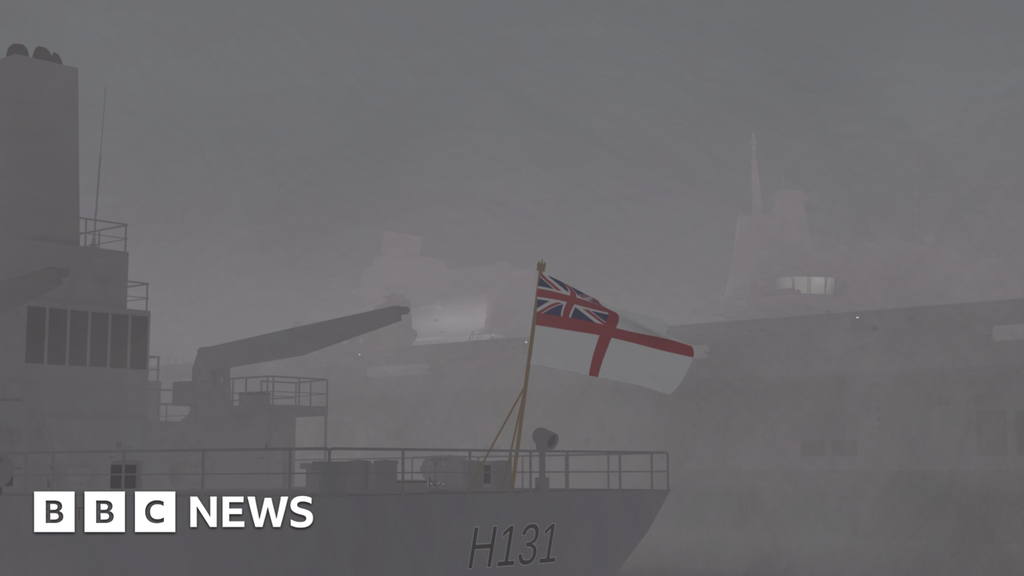
Royal Navy accounts have reported the arrival of British warships in Antarctic territory. Illustrative Roblox-style image; not a photograph of the reported deployment.
The diplomatic announcement has been accompanied by a visible British naval presence in Antarctica.
At approximately 18:28 on Tuesday, an account representing the Royal Navy published images of vessels in the British Antarctic Territory.
The accompanying announcement stated:
“Royal Navy vessels arrive in the British Antarctic Territory.”
The photographs showed British naval vessels operating in poor visibility, with the Union Flag and White Ensign visible.
A subsequent statement from the British Armed Forces Commentary account, published at approximately 19:01, confirmed that the Royal Navy had made landfall in the territory.
The account said:
“Following a treacherous voyage across the globe, the Royal Navy has finally made landfall in the newly designated British Antarctic Territory.”
It added that the Royal Navy would continue carrying out its duties despite the harsh Antarctic conditions.
The timing of the announcements places the naval arrival shortly after the Foreign Secretary’s statement, although it remains unclear whether the vessels were deployed specifically as part of the treaty or were already scheduled to operate in the region.
There has been no verified announcement of naval confrontation or combat involving New Zealand.
Royal Marines conduct Arctic warfare training
Separately, the Royal Marines have published images of personnel conducting Arctic and chemical warfare training near Camp Viking in Norway.
The images show personnel operating in snowy, wooded terrain.
The Royal Marines’ announcement stated:
“Royal Marines conduct Arctic & Chemical warfare training near Camp Viking, Norway.”
Although the training has been publicised alongside developments in Antarctica, there is no evidence that the exercises were ordered in response to the territorial dispute or that the personnel involved are being deployed to Antarctica.
The British government’s statement nevertheless makes clear that it intends to continue using the Antarctic territory for Armed Forces exercises.
Leaked correspondence now confirmed as part of wider negotiations
The Foreign Secretary’s announcement follows an earlier BBC News report concerning private correspondence attributed to the Marquess of Cholmondeley.
The messages, dated 6 October, appeared to show the Marquess proposing British diplomatic assistance to Antarctica in exchange for territorial recognition or concessions.
The correspondence also referred to the possibility of Britain seeking New Zealand’s suspension from the United Nations Security Council.
A further message proposed a future defence treaty.
At the time, BBC News could not establish whether the proposals were officially authorised or whether any agreement had been reached.
The latest government statement confirms that Britain and Antarctica had been negotiating a territorial and defence arrangement.
However, it does not specifically confirm that the Marquess’s correspondence was authorised, nor does it address the earlier suggestion of action against New Zealand at the Security Council.
The government has instead criticised the manner in which the private discussions became public.
This distinction remains important: the newly announced treaty confirms a reported outcome of negotiations, but not every proposal raised during those discussions necessarily became government policy.
British ultimatum raises new diplomatic questions
One of the most significant elements of the Foreign Secretary’s statement is the admission that Britain renewed its offer under the pressure of an ultimatum.
According to the government’s account, Antarctica initially rejected Britain’s conditions before subsequently agreeing to the Treaty of Rothera.
The statement does not specify the precise terms of the ultimatum, the deadline imposed or what consequences Antarctica would have faced for refusing.
It also does not establish whether Antarctica considered the final agreement voluntary or whether its government disputes Britain’s characterisation of the negotiations.
The circumstances surrounding the agreement are likely to attract scrutiny, particularly given the territorial sovereignty involved and the wider dispute with New Zealand.
What does the treaty mean for New Zealand?
The Treaty of Rothera comes amid an unresolved diplomatic confrontation between Antarctica and New Zealand.
New Zealand previously issued an ultimatum over the territorial dispute, prompting Antarctica to seek international assistance.
Russia has also publicly supported New Zealand, raising concerns about the possibility of wider international involvement.
Britain’s newly announced mutual defence arrangement could change the diplomatic calculations of both parties.
However, the exact scope of the treaty’s defence obligations remains unclear without examining the full agreement.
It is not established whether the treaty applies to existing territorial disputes, future attacks or specific geographical areas.
The Foreign Secretary’s statement also does not indicate that Britain has declared war on New Zealand or authorised offensive military action.
There has been no confirmed response from the New Zealand government to Britain’s announcement.
International Court of Justice ruling adds further complexity
The announcement also follows a judgment delivered by the International Court of Justice on 10 October in the case concerning sovereignty over the Ross Region.
The Court confirmed that its judgment was adopted unanimously by three votes to none, with no abstentions.
The proceedings were overseen by President BobJHawke and Judges 0dure and KamlaPBisessar.
Judge Bisessar appended a separate opinion, concurring in part.
The Court’s announcement did not itself disclose the substantive outcome, and BBC News has not independently verified which party prevailed.
The Ross Region proceedings and the Treaty of Rothera concern territorial sovereignty, but they should not be treated as resolving the same legal questions without further evidence.
It remains unclear whether the Court’s judgment influenced the negotiations or how its findings affect the new British agreement.
The ICJ judgment was published separately.
Foreign Office previously downplayed risk of confrontation
The latest developments also follow comments made to BBC News by the Permanent Secretary to the Foreign Office, Mark, following British diplomatic discussions in Kyiv.
Speaking about the dispute between New Zealand and Antarctica, Mark said:
“There is little concern of a wider regional or even global confrontation at this time.”
He also expressed confidence that the two parties would resolve their differences.
Those comments were made after the date of the previously leaked diplomatic correspondence and before the latest public announcement of the Treaty of Rothera.
The contrast between the Foreign Office’s earlier reassurance and the subsequent announcement of a territorial transfer and mutual defence agreement raises questions about how Britain’s position developed during the negotiations.
However, the new treaty does not, by itself, establish that the government’s earlier assessment was incorrect or that a wider military confrontation is imminent.
Analysis: A major shift in Britain’s Antarctic role
BBC NEWS | DIPLOMATIC ANALYSIS
Britain’s announcement represents a significant development in a dispute that has increasingly drawn the attention of foreign governments.
Three aspects of the latest developments stand out.
First, the British government has publicly confirmed that it negotiated for sovereignty over Antarctic territory in exchange for defence commitments.
Second, the Foreign Secretary has acknowledged that Antarctica initially rejected the proposal before accepting a renewed offer accompanied by an ultimatum.
Third, the Royal Navy has announced the arrival of vessels in the territory on the same day as the government’s statement.
Taken together, these developments indicate a more direct British role in the region than was apparent from the Foreign Office’s earlier public comments.
But several questions remain unresolved.
The legal scope of the territorial transfer has not been independently established. The detailed obligations of the mutual defence treaty remain unverified. And the government’s statement does not clarify whether Britain intends to take action against New Zealand at the United Nations.
The distinction between a diplomatic agreement and a military escalation is also important.
While Britain’s naval presence is now being publicly highlighted, there is no confirmed evidence of hostilities involving British forces.
Questions facing the British government
The Foreign Secretary’s announcement leaves a number of issues requiring clarification:
- The ultimatum: What deadline and consequences were presented to Antarctica before it accepted the agreement?
- The territorial transfer: What boundaries and sovereignty provisions are specified in the Treaty of Rothera?
- The defence commitment: Under what circumstances would Britain be required to provide military assistance?
- New Zealand: Does Britain still intend to pursue any Security Council action against Wellington?
- The Armed Forces: Were Royal Navy vessels dispatched as a result of the agreement, or was their arrival previously planned?
- Antarctica’s position: Has the Antarctic government independently confirmed its acceptance of the treaty and the territorial transfer?
The answers will be important in determining the full diplomatic and military significance of the agreement.
Emergency House of Commons sitting held amid Antarctic treaty announcement
An emergency sitting of the House of Commons was held in Westminster on Tuesday evening, as the British government announced a major territorial and defence agreement with Antarctica.
The session was announced at approximately 17:01, with members of the public invited to attend proceedings at the Palace of Westminster from 18:00.
A further announcement at 17:51 provided access to the parliamentary session, which was subsequently confirmed to have concluded at approximately 18:20.
The sitting took place on the same day that Foreign Secretary AdrianJWilliams announced the Treaty of Rothera, under which Britain says Antarctica has agreed to transfer sovereignty over the British Antarctic Territory in exchange for mutual defence commitments.
The timing of the emergency session nevertheless adds to a day of significant developments in British foreign policy, with questions continuing over the government’s negotiations with Antarctica and the circumstances surrounding the agreement.
What happens next?
Attention is now expected to turn towards the responses of Antarctica, New Zealand and other governments with an interest in the dispute.
The publication of the Treaty of Rothera provides a basis for examining the precise commitments made by both parties.
The arrival of Royal Navy vessels also raises questions about how Britain intends to exercise its newly asserted authority over the territory.
For the British government, the announcement marks the culmination of negotiations it has publicly described as a diplomatic victory.
For the wider international community, it introduces a new defence arrangement into an already sensitive territorial dispute.
BBC News will continue to follow developments as governments respond to the Treaty of Rothera and Britain’s expanding presence in Antarctica.